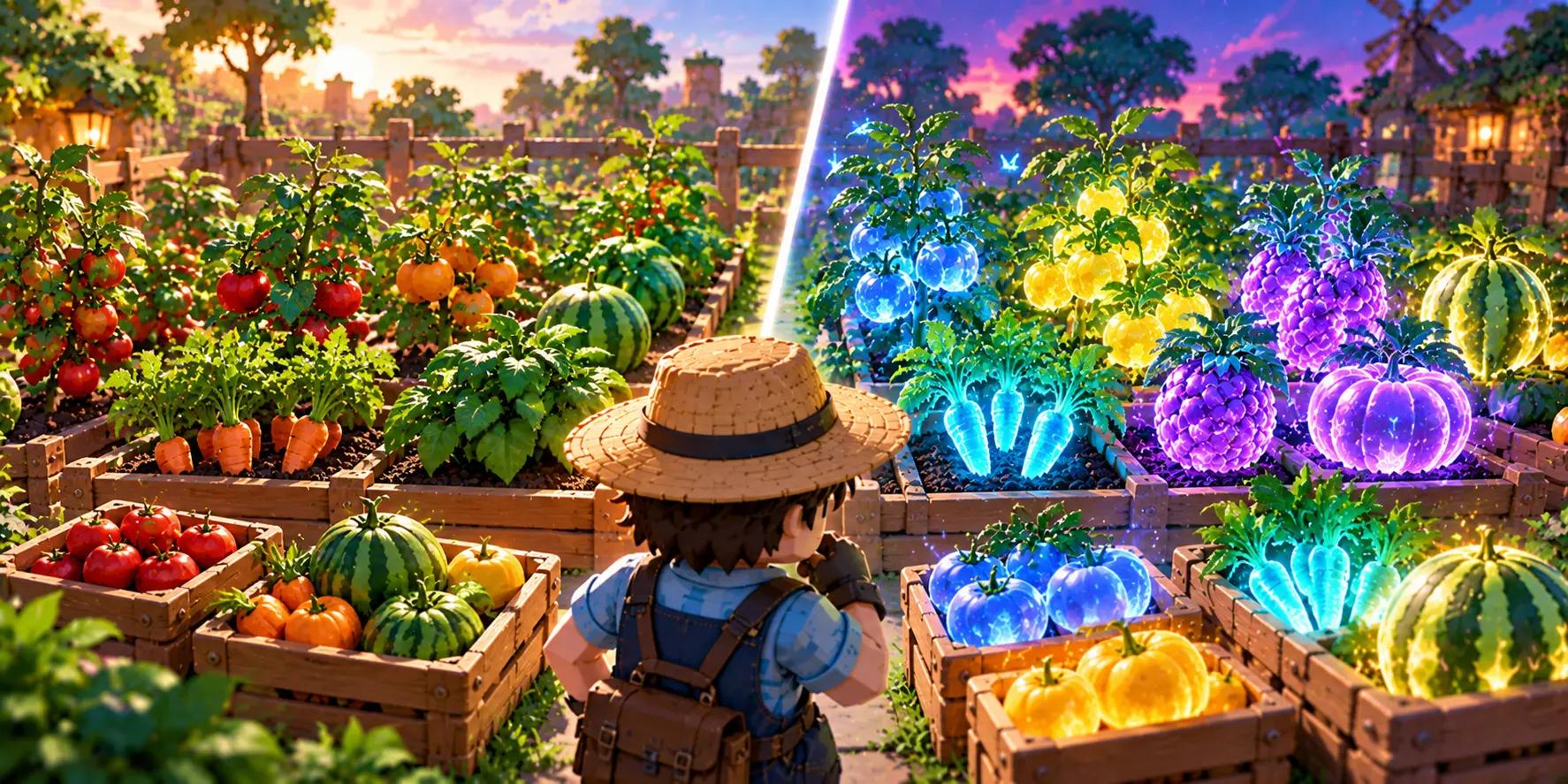
farming Tranquil cropsUnderstanding normal crops vs mutated crops in Grow a Garden helps players make better decisions about planting, harvesting, and managing valuable produce. A normal crop grows without an additional mutation effect, while a mutated crop has gained one or more special characteristics through the game’s mutation mechanics.
The important point is that a mutation usually changes the status of the produce rather than replacing its underlying crop identity. This means the same basic crop type can appear as ordinary produce or as a mutated version.
What Are Normal Crops in Grow a Garden?
normal crops vs mutated crops are plants or produce that have not received an additional mutation.
They form the basic foundation of a garden. Players plant seeds, allow crops to grow, and harvest their produce according to the normal farming cycle.
A crop does not need a mutation to be useful. Ordinary crops remain important because they provide the produce that mutation mechanics can potentially affect.
A simple farming sequence begins as:
Plant → grow → mature → harvest
When mutations enter the process, another layer is added before collection.
What Are Mutated Crops?
Mutated crops are produce that have received an additional effect through an applicable game mechanic.
Instead of becoming an entirely unrelated crop, the produce retains its underlying identity while gaining a mutation.
The process can be understood as:
Normal produce + mutation effect = mutated produce
This distinction matters because players sometimes search for mutated crops as though every mutation requires a completely separate seed. In many cases, the mutation is applied to produce that already exists in the garden.
Normal Crops vs Mutated Crops: What Changes?
The main difference is the presence of an additional mutation effect.
A normal fruit represents the crop in its basic state. A mutated fruit carries another property that can affect how the player evaluates, manages, or harvests it.
This creates different farming decisions.
Normal produce may be harvested immediately as part of routine farming. Mutated produce may deserve closer inspection before collection, especially when the player is targeting a specific mutation or participating in related gameplay.
Therefore, mutation farming adds a decision stage:
Grow → mutation opportunity → inspect → keep or harvest
That extra inspection step can become important in a garden containing several mutation types.
How Do Crops Become Mutated?
Mutations can be connected to different game mechanics, events, environmental effects, or pet abilities.
The exact method depends on the mutation being targeted.
For example, Tranquil-related gameplay includes mechanics that can provide opportunities for suitable produce to gain the Tranquil mutation. Players interested in farming Tranquil crops should therefore focus on both crop availability and the mechanics capable of applying that effect.
The key idea is that a player often needs suitable produce present when a relevant mutation opportunity occurs.
Harvesting everything immediately can reduce the number of available targets.
Why Keep Normal Crops When Farming Mutations?
Normal crops are not separate from mutation farming. They are often the starting point.
If mutation mechanics affect existing produce, players need crops available before those mechanics can be useful.
This means ordinary produce can have strategic value even when the player’s ultimate goal is mutated fruit.
Instead of clearing every mature crop as soon as possible, mutation-focused players may choose to keep selected produce available.
However, there is little reason to stop harvesting the entire garden. A balanced approach allows normal farming to continue while maintaining enough potential mutation targets.
How Can You Recognize Mutated Produce?
Mutated produce may display visual or status differences compared with its normal version.
Comparing nearby fruits of the same crop type can help players notice when one has changed. However, visual effects should not be the only consideration, especially in a crowded garden.
When possible, inspect the produce and confirm its mutation status before harvesting.
This becomes particularly useful after a mutation-related event or pet interaction.
A simple habit can prevent mistakes:
Inspect first, harvest second.
Players who automatically collect every mature fruit may remove useful mutated produce before noticing it.
Do Mutations Change Crop Value?
Mutations can affect how players value particular produce.
This is one reason mutated crops often become a separate farming objective rather than simply a visual variation.
However, players should evaluate the actual mutation attached to the crop instead of assuming every mutated fruit has identical importance.
Different mutations can have different effects and uses. Therefore, the presence of a mutation is only the first piece of information.
The specific mutation matters.
For Tranquil farming, for example, the player should confirm that the produce actually carries the Tranquil effect rather than assuming any unusual-looking fruit qualifies.
Can a Crop Have More Than One Important Characteristic?
Crop management becomes more complex when players begin dealing with multiple effects and farming objectives.
A crop’s base identity, maturity, mutation status, and intended use can all influence whether it should be harvested.
This is why advanced farming is less about collecting everything immediately and more about evaluating individual produce.
Before harvesting an important fruit, ask:
- What crop is it?
- Does it have a mutation?
- Which mutation does it have?
- Do I need it for a current objective?
- Should I preserve it temporarily?
These questions take only a moment but can improve garden management significantly.
Where Do Pets Fit Into Crop Mutations?
Some pets have abilities that interact with crops or mutation systems.
When a pet can contribute to mutation opportunities, keeping appropriate produce available becomes part of the strategy.
The pet does not necessarily change the underlying identity of the crop. Instead, its ability may interact with existing produce and potentially contribute to a mutation-related result.
Players should always consider the conditions of the specific pet ability.
Simply equipping a mutation-related pet does not mean every crop will automatically receive the desired effect.
Mutation Creation vs Mutation Collection
Another useful distinction is the difference between creating mutated produce and collecting it.
These are separate stages.
A mutation mechanic acts before or while the crop gains an effect. A collection mechanic becomes useful after the desired mutated fruit already exists.
For example, a tool designed to help collect a particular type of mutated fruit should not automatically be treated as a tool that creates that mutation.
Thinking in stages makes the system easier to follow:
Grow crop → obtain mutation opportunity → identify mutated produce → collect or preserve it
Each step has a different purpose.
Should You Harvest Mutated Crops Immediately?
Not always.
The correct decision depends on what the player is trying to accomplish.
If the mutated fruit is needed immediately, harvesting may make sense. If the player wants to protect it, compare it with other produce, or preserve it for a specific purpose, leaving it temporarily can be more useful.
Favoriting or other available protection behavior can also help prevent important produce from being collected accidentally.
This becomes especially helpful in large gardens where many mature crops are being managed at once.
A Better Strategy for Managing Normal and Mutated Crops
Instead of treating normal and mutated crops as completely separate farming systems, use them as parts of the same cycle.
Start by maintaining productive crops. Keep selected mature produce available when targeting mutations. When a relevant mutation opportunity occurs, inspect the garden before harvesting.
Identify which fruits remained normal and which gained an additional effect.
Then decide what should be collected and what should remain protected.
This approach keeps the garden productive while still supporting mutation farming.
Understanding the Difference Improves Farming Decisions
The central difference between normal crops vs mutated crops is simple: normal produce has no additional mutation effect, while mutated produce carries an added characteristic created through the relevant gameplay mechanics.
Normal crops still matter because they often provide the foundation for mutation opportunities. Mutated crops require more careful inspection because their additional effects can change how players choose to manage them.
By separating crop identity, mutation status, mutation sources, and collection mechanics, players can make more deliberate harvesting decisions and build a more organized Grow a Garden farming strategy.