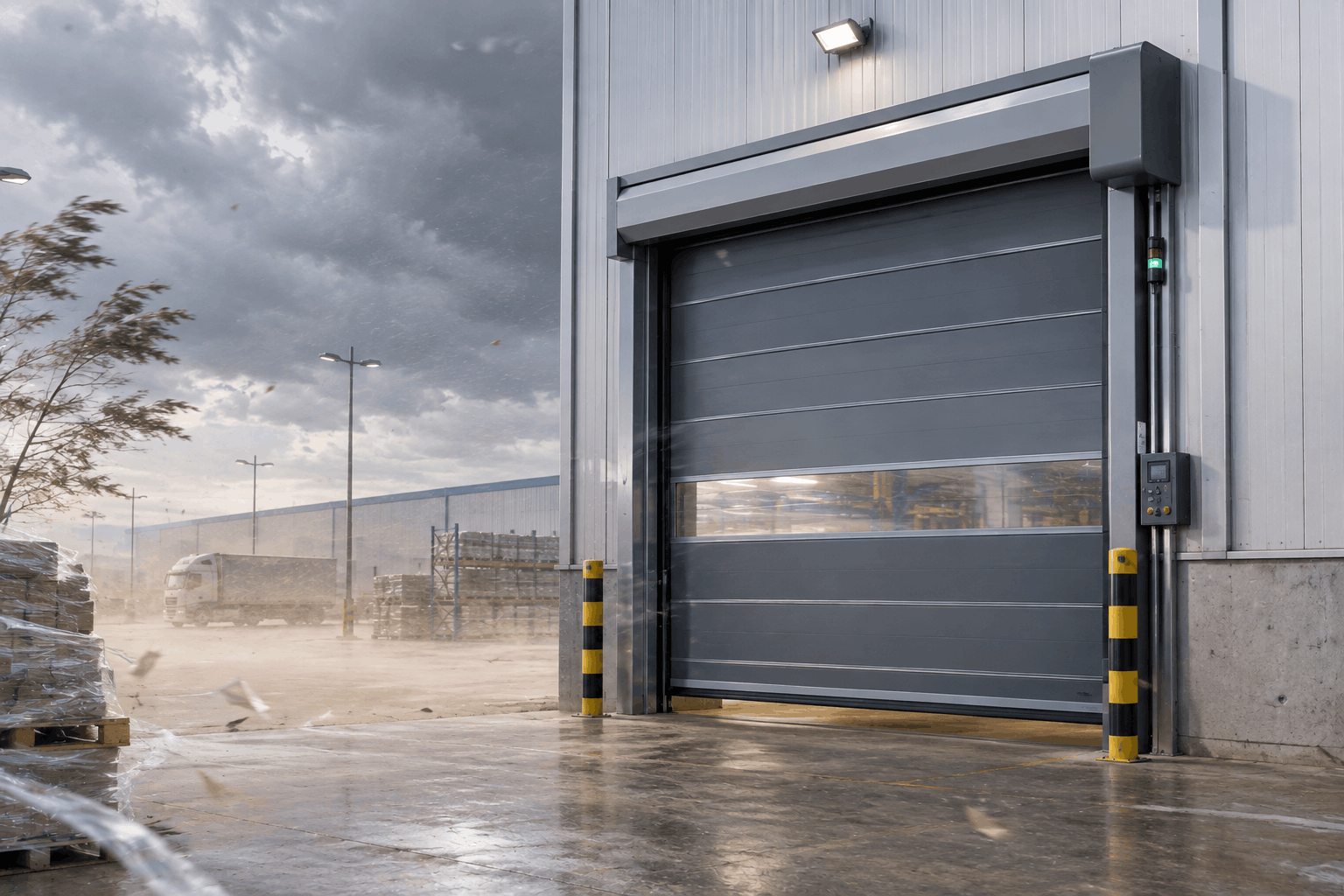
Industrial door wind resistance is an important consideration when selecting a door for an exterior warehouse, factory, loading area, or other exposed entrance. Wind can place additional pressure on large door surfaces, while rain, dust, and changing weather can also affect the performance requirements of the entrance.
The right industrial door should therefore be selected according to the site’s exposure, opening dimensions, traffic pattern, construction, sealing requirements, and installation conditions. Wind resistance is one part of a broader assessment rather than a specification that should be considered by itself.
Why Does Wind Resistance Matter for Industrial Doors?
An exterior industrial entrance can be exposed to wind from different directions and at different intensities. A large door opening presents a substantial surface area, so the construction and support system need to be appropriate for the location.
Wind exposure can influence several aspects of an industrial door:
- Structural stability
- Panel or curtain movement
- Sealing around the opening
- Door operation
- Weather protection
- Maintenance requirements
- Overall entrance reliability
The importance of each factor depends on whether the door is installed inside a building, at a sheltered loading dock, or on a fully exposed exterior wall.
What Determines Industrial Door Wind Resistance?
Wind performance is influenced by the complete door system rather than one component.
Door construction
Rigid panels can provide a different structural arrangement from flexible fabric curtains or conventional lightweight coverings. The construction should be selected according to the required opening size and environmental conditions.
Large exterior entrances may require a door configuration specifically designed to manage the forces associated with wind exposure.
Opening dimensions
The larger the entrance, the more important accurate engineering becomes. Door width and height affect the surface exposed to wind as well as the supporting structure and operating mechanism.
A door that works well in a small sheltered opening should not automatically be assumed to be suitable for a much larger exposed entrance.
Guide and support system
The way the door panels or curtain are guided can affect how the system responds to environmental forces. Appropriate guides, tracks, supports, and mounting arrangements should be considered during installation planning.
Building location
Wind exposure varies considerably between sites. A warehouse surrounded by other buildings may have different conditions from a standalone facility, an open industrial yard, or a building in a coastal or elevated area.
The surrounding site should therefore be considered when determining the appropriate door configuration.
How Does Wind Affect Sealing?
Wind resistance and sealing are closely related, but they are not identical.
A door may have a structurally suitable design while still allowing unwanted air movement around its edges if the sealing arrangement is inadequate. For facilities concerned about dust, rain, temperature control, or air exchange, the perimeter seals and closing behavior deserve attention.
A properly configured industrial entrance should provide a suitable balance between structural performance and environmental separation.
This can be especially relevant where an exterior door separates a warehouse from a loading yard. The entrance may need to accommodate frequent forklift traffic while also limiting exposure to outdoor conditions when closed.
Choosing a Door for a Wind-Exposed Warehouse Entrance
When evaluating an exposed warehouse entrance, begin with the operating environment.
Ask how often the door will open, what vehicles pass through it, how large the opening needs to be, and whether the door is directly exposed to prevailing winds.
For high-frequency traffic, the operating system also matters. A door that opens and closes efficiently can reduce the time the entrance remains open, while appropriate sensors and controls can help coordinate movement.
Facilities researching high speed spiral door systems can compare configurations according to opening dimensions, operating requirements, panel construction, environmental conditions, and available installation space.
Wind Resistance Is Not the Same as Weather Protection
It is useful to separate several related requirements when choosing an exterior industrial door.
Wind resistance concerns the door’s ability to withstand the forces associated with wind exposure.
Water resistance concerns how well the closed entrance limits rain or water penetration under applicable conditions.
Air permeability relates to unwanted air movement through or around the closed door.
Thermal insulation concerns the transfer of heat between different environments.
A facility may need several of these characteristics at the same time. For example, an exterior warehouse entrance could require appropriate wind performance while also needing effective sealing and insulation.
What About High-Frequency Door Operation?
Wind exposure is only one part of the operating environment. A busy entrance may open and close repeatedly as forklifts, trucks, or other vehicles move between indoor and outdoor areas.
In such applications, the door should be evaluated for its operating cycle, drive system, controls, safety features, and maintenance requirements.
Automation can also influence how the entrance behaves during normal traffic. Radar, induction loops, photoelectric sensors, access-control systems, and other devices can be configured according to the site’s requirements.
The objective is to create an entrance that responds appropriately to traffic while maintaining suitable environmental separation when closed.
Questions to Ask Before Selecting an Exterior Industrial Door
How exposed is the entrance?
Determine whether the opening is sheltered by another structure or directly exposed to outdoor conditions. Nearby buildings and the site’s orientation can affect the environment around the entrance.
How large is the opening?
Record the required clear width and height. Large openings should receive particular attention during engineering and installation planning.
What type of traffic uses the door?
Forklifts, trucks, automated guided vehicles, and pedestrians can have different access requirements. The door’s operating speed and safety controls should match the traffic pattern.
Is temperature control important?
If the door separates conditioned or temperature-sensitive areas from the outdoors, insulation and sealing should be considered together with wind performance.
What safety systems are needed?
Automated doors may incorporate photoelectric detection, light curtains, safety edges, emergency controls, or other protective systems. The appropriate combination depends on the application.
What maintenance access is available?
Exterior doors are exposed to changing environmental conditions. Routine inspection and maintenance should therefore be practical and included in the facility’s planning.
Can a Fast Industrial Door Also Handle Exterior Conditions?
Potentially, depending on the specific design and application. High-speed operation and environmental performance address different requirements, so buyers should examine the complete door configuration rather than assuming that speed alone determines suitability.
For example, a warehouse may need rapid vehicle access during busy periods while also requiring a rigid construction capable of handling an exposed exterior location. In that situation, the door should be assessed for its structural design, wind performance, sealing, automation, safety, and cycle requirements as one system.
A Practical Selection Approach
A useful evaluation process starts with the building rather than the product catalogue.
First, measure the opening and available installation area. Next, identify the site’s wind and weather exposure. Then document vehicle traffic, operating frequency, temperature requirements, and safety considerations.
After that, compare suitable industrial door configurations against those requirements. Ask the manufacturer or installer for the technical information relevant to the actual opening and site conditions rather than relying on a generic description.
For exposed industrial entrances, wind resistance should be treated as part of a broader performance picture. Considering structural design, sealing, weather exposure, operating frequency, automation, and maintenance together makes it easier to select a door configuration that fits the building and its day-to-day demands.